Search This Blog

Thursday, June 11, 2020

What taboo topic are men afraid to discuss? and women don't want to hear?

This article is taken from here.


Her breasts were fantastic. Round and perky, these breasts did not belong to someone who had been through two pregnancies and an attempted breastfeeding. They were the breasts of a young, child-free woman.

I sighed. He would love those breast. I am not a jealous person. I don’t like competing with other women (or anyone, really). And my amazing boyfriend has never given me any reason to question his loyalty or devotion.

But thoughts like these now frequently interrupt my days … as I drop off a package at UPS, pump gas, or roam aisles of Target. I can’t help it. It’s like I’m in a constant state of shock and anxiety, but in slow motion.

The truth is I never really noticed other women’s bodies before unless they were shockingly fit or wearing something I might want to buy. But this wasn’t before. This was after – after I read the book.

The book I am talking about is Through a Man’s Eyes by Shaunti Feldhahn and Craign Gross. It gives women an inside look at what the expression “men are visual” means. It details how a man’s eyes are uncontrollably drawn to look at women’s bodies as they move about their daily lives.

And it’s alarming – at least it was to me, because I was so totally unaware of the frequency and magnitude of this temptation.

The book opens with a detailed description of a day in the life of a typical man, how his eyes are drawn like magnets to look at women’s bodies and the near constant white-knuckling determination it takes to keep from openly staring.

The authors describe how these images are both annoying interruptions and pleasurable distractions to men at the same time. And they reveal how utterly oblivious women are to men’s reality.

We have noticed this irony: men are visual … and women are blind to it,” they write. “All too often, we simply don’t see – or we completely misunderstand – a man’s visual nature.”

What “men are visual” really means

The phrase “men are visual” was not new to me. I’d heard that expression many times over the years. But I didn’t understand it at all. I thought it means that men like to date/have sex with women who are attractive.

I did not know that “men are visual” is a way of saying that men are constantly visually drawn to look at women’s bodies all the time – a co-worker wearing a slim-fitting pencil skirt, a woman at the coffee shop whose top button is unbuttoned, a friend at the gym wearing leggings that show off her curves.

And it isn’t just attractive women, women who are their type or women who are in their preferred age range. It isn’t women who are dressed in sexy clothes or wearing makeup or who have physical attributes they prefer. A leg man will still feel compelled to look at waists and breasts. A breast man will look at hips. It isn’t even live women – one man described feeling compelled to look up a mannequin’s dress!

Moreover, it is something they simply can’t turn off.

I thought those visual cues might be accompanied by desire, which apparently they are, but I did not realize those feelings are often fleeting, much the way I might covet a piece of chocolate cake when walking past a bakery window, then forget about it hours later.

I also did not realize that these feelings are (often? Always?) not romantic. This was especially hard for me to understand, as my feelings of desire are nearly always connected to romance. I may be in the minority of people in that regard.

It isn’t a moral issue

It is tempting for those of us with two XX chromosomes to dismiss Gross and Feldhahn’s descriptions as religious proselytizing in an attempt to curb sexual expression, because authors are Christian and write for a Christian audience. We might disagree with their anti-porn stance or think their views are fundamentalist, reactionary or unenlightened.

That would be a mistake.

I am neither Christian nor anti porn, and I learned a ton from this book. After reading it, I asked my boyfriend how often he felt compelled to look at women’s bodies in a given day, week or month.

He looked at me incredulously. “You mean how often in a minute?” he asked.

WOW.

He also assumed that women are equally as distracted by men’s bodies. “I’ve seen women comment on men,” he noted, citing two examples of women friends’ who’ve made comments about an attractive man’s body.

Women are not the same

I tried to explain that for women, it’s entirely different because it’s something we can turn on and off. If we’re in the mood to look at men, we will. If not, we won’t.

Moreover, for some of us, our relationship status can change the way we look, how often we look and even whether or not we notice men at all.

Truth be told, more often than not, I don’t even notice men’s bodies unless the man is especially fit or attractive. When I was un-partnered, I noticed men more frequently, but if I had to put a number on it, I’d say maybe five times a month.

I may be unique or I may be representative of most women. I am not sure, but I suspect it’s the latter.

Since reading this book, I did become hyper aware of a behavior (drive? Neurological response? Hormonal difference?) that had totally eluded me before. I thought I understood that some men ogle women, that most men like to look at attractive women and that men frequently think about sex.

The truth is I drastically underestimated the extent of all of those things.

Why? Because of the most part, I’ve been with good men. By “good” I mean men who treat me well, are considerate of my feelings and try conceal their magnetic, powerful drive to look at other women. I view this as incredibly respectful. I appreciate it. And I am aware that most men behave this way.

Do they deserve a medal for this? I don’t know. What I do know is that it would be hard for me to operate in the world the way they do.

I honestly can’t imagine what it must be like to experience involuntary interruptions of that magnitude all the time. Sure, some of the time those interruptions might be welcome, but the men I asked about this said that more often, they are powerful distractions that keep them from achieving their goals, completing tasks or focusing on what they want to.

My initial reaction to this book was revulsion (and maybe denial at first, because you’ve got to have a little denial in any honesty soup), followed by insecurity, and finally an attempt to understand. I don’t think it was the authors’ attempt to make women feel insecure – in fact, I think it’s the opposite – that’s just what I felt initially.

Where do we go from here?

I am sure there will be discussion about what causes this – the free availability of porn, the sexualization of women in our culture, the patriarchy at large. But I don’t think any of those things are the point. I really think this is an innate drive that men should continue to discuss honesty and women should strive to understand.

I suspect that outing it openly like this will get me in trouble with both men and women. Men won’t like being reduced to generalizations (I am sure there are men to whom this doesn’t apply), or they will assume that women are wired the same way they are and that I am somehow calling them out for being human. Perhaps they will worry about getting in trouble with their wives and girlfriends.

Women will accuse me of excusing what they deem to be bad behavior on the part of men.

Neither in an accurate representation of my intentions. My intention is simply to illuminate and understand. I am merely sharing an insight that changed my life and ultimately improved my relationships with men, with the hope that it may help improve yours as well.

My sense is that the more we understand other people, the better off we will all be.


Thursday, June 04, 2020

Toxic person?

the writing is taken from here

HOW TO KNOW IF YOU’RE THE TOXIC PERSON EVERYONE’S TRYING TO AVOID


While it’s true that other people’s opinions about us don’t matter in the way we fear they might, it’s also true that other people’s collective response to us can tell us pretty much everything we need to know about who we are.

It is a brutal course in self-awareness, to realize the pattern in the way people react to us so much about how we are in the world.

And yet it is so true.

It’s a good sight that you’re willing to wonder how your actions affect other people. The most toxic among us are also the least self-aware. They are the last to admit that they are the problem.

If you are a toxic person, you’re not going to resonate with the warning signs that are listed for people trying to identify one in their lives. If you’re well enough to at least recognize it and try to work on your poor relationships with other people, you will likely resonate with any of the following.

·         You have severe social anxiety and fear of public humiliation.

·         You avoid and criticize people as a means of dominating them.

·         When friend share part of their lives with you, you pick out what’s wrong rather than expressing happiness for them.

·         You are constantly trying to coach of “fix” the friend or family member with whom you have a poor relationship. You are constantly harping on why their behavior is unacceptable, but at the same time you don’t remove yourself from your relationship with them.

·         You have very few friends, and are highly attached to the ones that you do.

·         You only express love or admiration when you need something.

·         In the past year, you have not once admitted to another person, I was wrong, I will do better.

·         You oscillate between feelings as though you have a grandiose, god-like purpose on Earth, and feeling as though you are one of the most disgusting, unworthy beings to ever exist.

·         You do not get along with many people fundamentally, but you know you’re able to charm them into liking you one way or another.

·         You notice that people tend to step away from relationships with you, and seemingly avoid you.

·         Many people have negative things to say about you, but there seems to be a consensus about what those negative things are, and you seem to make enemies virtually everywhere you go.

·         You are at least marginally aware of past trauma that’s keeping you feeling vulnerable, exhausted and in pain almost all of the time.

Whether or not any of the above resonates with you, the final litmus test is this: are you a consistently negative presence in someone’s life, and yet seem to always manage to convince them to keep you around? Are you at least somewhat aware that you’re hurting someone, and yet feel too afraid to apologize, or stop?

The first thing you need to know is that you are not alone, you are okay, but you have a lot of healing to do.

Your toxicity in your relationships with other people is actually an extension of the toxicity in your relationship to yourself. What you have is not an issue with how you relate to others, but a fundamental trauma that is preventing you from being at ease within yourself. That is what you must address. You can enlist the help of a medical professional to help you, and in fact, you should.

But the first thing you need to do is listen. If someone tells you that you are hurting them, do not respond with a list of reasons why you are not.

Do not deny that you are negatively impacting someone’s life if they claim you are. People do not say such things for no reason.

Right now, empathy might feel like too huge of a shift to fathom. That’s okay, you don’t have to begin there. Start, instead, with trying to have compassion for yourself, and gently removing yourself from relationships in which you are not a positive presence in another person’s life.

The coming weeks, months and even years will be a time for you to spend by yourself, sorting out your own traumas. You are not hurting others because you are a bad person, you are hurting others as a defense mechanism. That doesn’t make it okay, but it does give you an explanation.

And most importantly, it means that you have to heal.

If not for yourself, but for the sake of others.

Do not allow your legacy to end like this. Do not allow your life to be like this.

Apologizing is a start, but it doesn’t solve the problem. The work that is yours is to change who you are. It is time to be selfish in the sense that it’s time for you to stop worrying about what’s wrong with everyone around you and start really focusing on what needs to change within you first.

The happier you are, the kinder you will be. You are not helpless, you’re just wounded. There is a light, and you can see it.


Tuesday, June 25, 2019

What I’d Like Every Woman To Know About Married Men Who Cheat


this article was copied from here


What I’d Like Every Woman To Know 

About Married Men Who Cheat


I’ve written about my experience as “the mistress.” It was an article that unleashed both an outpouring of emotional confessions and unbridled fury against me.
There’s not one part of me that condones cheating. Before my experience sleeping with a married man, I was the type to utterly condemn people who had affairs. I had zero sympathy for people like that. And then — it happened to me.
Long story short — the affair was full of heartbreak, chaos, and abuse.
I was 100% responsible for my own actions and I’ve come out of the experience with new wisdom.
With this wisdom, I want to continue talking about this subject because it’s become clear to me that many kind, intelligent, women have also found themselves embroiled in affairs from which they can’t seem to easily get themselves out of.
It’s not always about an evil vixen who only has intentions of stealing another woman’s man. Often times, it’s a sensible, functional woman who slips and falls for a person who is incredibly experienced in manipulation and deception.
There are subtle, insidious ways in which a married man who cheats on a regular basis can seduce a smart woman.
In the beginning, these guys are often friendly, charming, and non-threatening. They might start out making idle conversation and some of them will openly discuss their wives and family seemingly with the pride of a happily married man. Generally, whether you’re a single woman or a woman in a relationship, you won’t think too much of this kind of casual chit chat.
Quite often, this kind of interaction happens in the workplace (which is where it happened with me) but it can also happen in other settings.
Typically, most married men who are serial cheaters begin to groom their intended target by showering them with compliments, acting as a shoulder to lean on, or even going so far as to bring them gifts. Eventually, they’ll find a way to get your phone number, stalk you online, or find some other means to communicate with you on a regular basis.
Most of the time, it’s not important to this kind of guy if the woman is married, in a relationship, or single. There are, however, married men who are looking to aggressively control just one woman as their mistress and will choose a single woman so they can isolate her more easily from family and friends.
The character I became involved with was a serial cheater. I was single and recovering from my divorce at the time. I didn’t find out about his many dalliances until we started talking more. He was very open about it after several conversations. I would even go so far as to say he normalized his behavior as if it was what everyone did.
The main kicker is when this type of man begins to confide in you about how miserable they supposedly are within their marriage. They’ll start to gripe about their spouse in such a way that leads you to believe they are headed for a separation or divorce. They may also complain about their sex life — or lack of — in most cases.
Many men will express a decline in attraction to their spouse, insinuating they’re deprived sexually in some way.
One of the most common tactics a married man who cheats will use is to lie about their current living situation. The most common lie is that they’re sleeping in separate beds or on the couch because they need to stay in the home for some reason. Usually it’s, “for the kids.”
They may also go as far as to say divorce papers are close to being signed (as in my case). Most of the time, this is not the case, and usually they are still sleeping in the same bed with their spouse and are sexually active with them.
Unfortunately, for a lot of women, once they have sex with someone — even if it’s with someone who’s married — they may start falling in love and believe pretty much any lie they’re told. Believe me — I know.
The person I became involved with was a controlling, jealous, manipulative cheater. Though he had engaged in multiple affairs, he didn’t want me to see anyone else outside of our relationship. It sounds insane, but so many women find themselves in this trap.
Finding yourself in a seriously complicated and stressful relationship with no easy way to extract yourself is not a healthy place to be. Affairs can flip from passion to anxiety very quickly. It’s almost never worth it.
The carnage of an affair can last a lifetime. For the most part, married men who are regular cheaters never have intentions to leave their wives. Essentially they want it all — at everyone else’s expense.
I can’t change what happened in my past but hopefully, what I’ve learned from my experiences can help someone who’s in this kind of situation right now.

To The Single Woman Who Has Given Up On Relationships — But Still Really Wants One

this article was copied from here.

To The Single Woman Who Has Given Up On Relationships —  But Still Really Wants One


To the single woman who has completely given up on dating and relationships, but still has the desire for a partner: I want to tell you something. I may not be in your shoes at this moment because I’m now married, but I was once perpetually single. I gave up. I didn’t even go out or attempt to meet anyone. I was done.
I was single for many years in my late 20’s and early 30’s. I wish I could say it’s because my standards were too high, but it wasn’t. I didn’t even learn how to have standards until I’d already made one terrible relationship decision after the other.
It’s okay to not want to be in a relationship or to not want to deal with the mess that relationships are at times. If you’re rockin’ the single life and want to enjoy it for many years to come — more power to you. But if you’re still single and you are wishing you had someone, I’m here to tell you that it’s not impossible, even if it seems like you’ll be alone forever.
There’s a theory out there that if you want to be in a long-term relationship with someone you have to “settle.” But what does that really mean? Does it mean you have to lower your standards for wanting a kind, committed person who loves you? NO. Does it mean you might have to put up with someone’s weird habits or odd interests?
Actually, YES.
I am not the perfect partner. I’m moody, I’m messy, and I’m kind of a control freak for starters. I’ve made some very unfortunate relationship choices in my lifetime. I married an abusive person who was addicted to drugs — eventually divorcing. After that, I ended up having an affair with a married man who was also abusive. Then I tried my hand at online dating but didn’t find anyone who fit what I thought I wanted.
Needless to say, I was definitely challenged in the romance department. I didn’t think I deserved better than what I was choosing. And I paid a steep price. I lost valuable time and the hope that I’d ever find a partner in life who truly cared about me.
I thought I was destined to be alone. I thought there was something wrong with me — a defect that prevented me from having happy relationships with healthy individuals. In reality, I just needed to reset my expectations and learn how to be healthy and functional on my own first.
We are all flawed in so many ways. Someone who you may think is less attractive than you, less intelligent than you, or even less “together” than you may have no problem finding a loving partner. You could be the most compassionate, funny, successful, desirable, well-organized person on the planet and still not find anyone who sticks with you.
Everyone has something going on that hinders their chances of opening up to a potential love interest. Some people have trust issues that need to be overcome. Some people have trouble communicating their needs properly and have to work harder at it. Some people have held on to a very specific set of expectations for an ideal partner that they may need to let go of — at least a little bit.
If you truly want to find a long-term partner, you may have to endure some initial discomfort. You may have to talk about your feelings when you’d rather not. You may have to compromise on certain expectations you’ve carried around with you. You may have to deal with the reality of someone’s idiosyncrasies.
There is never going to be the perfect time. There is never going to be the perfect person. Certainly, if you never leave your house or meet anyone outside of your bubble it may never happen at all. Get yourself out of your comfort zone. Get out in the world. If you don’t want to do that, then try a reputable dating site.
What you think you want in a partner may not be the best or healthiest choice for you. Be open. My current partner did not fit my “type” at all, but going on a date with him ended being the best chance I ever took.
I’m not telling you to “settle.” I’m telling you that if you want to find a person to have a relationship with who cares about your well-being, cheers for your successes in life, and truly loves you — you’ll not only need to learn how to accept their flaws just as you want yours to be accepted, but you may also have to simply take a chance.

Wednesday, April 10, 2019

The Human and the Kafir: How Fear of Apostasy Fuels Islamist Power

This article was copied from here.

Since 2008, I have been working with a team of dedicated and resourceful people on the Council of Ex-Muslims of Britain’s online forum and its associated social media, including its YouTube channel that has over 2.2 million views, and its Twitter accountthat currently has over 13 thousand followers. In September of last year, a handful of friends and I co-founded the organization Ex-Muslims of North America, or EXMNA. We have set up local meetup groups in 11 cities in just over a year, and the organization continues to grow. In just a few years, I’ve seen the idea of apostasy from Islam grow exponentially, and today there are a number of open, public Ex-Muslim freethinkerswho are writing, blogging, podcasting, doing interviews, speaking on panels at conferences, and generally putting their names, faces, and voices out there.
This is not to say we are all alike. In fact, this is important: I can’t say that any one of us speaks for all people who have left Islam; each of us really only speaks to our own experiences, although there definitely are commonalities. Still, the fact that there are so many diverse Ex-Muslim voices out there now – and the number keeps growing – is something I cherish very much, because I clearly remember the time before all this.
I was born and raised in Pakistan, lived in the US for many years, before settling in Canada. I had questions about Islam from a young age: aspects like the second class status of women in its scriptures and laws, the absolutely insane concept of hell and eternal torture, and general questions about things like, if god made everything, who made god, etc. etc. After trying to silence those questions in myself, I finally realized around age 19 that I was just not cut out for this religion thing.
Back in the late 1990s when the Internet was just learning to crawl, dial-up was the norm, and Google was yet to be born, I thought I was the only person in the entire world to have realized I couldn’t believe in Islam anymore. That I was not Muslim anymore. Islam is taught to most of us from Muslim backgrounds in such a way that it becomes woven into the very basic fabric of our identity. This is why one of the most common statements every Ex-Muslim makes at some point or another is: “I thought I was the only one!” Over the last 6 years that I’ve been involved in this movement, I have personally gotten to know a few thousand Ex-Muslims online and offline, and that is the most common line that almost all of them say at some point.
In the next few minutes, I will suggest some ideas about why I think this is so.
Probably more than any other religion practiced today, Islam permeates every aspect of life, from spiritual concerns to daily habits like what to eat, what to wear, who to associate with, and even how to go to the bathroom. When every aspect of your being is ruled by an ideology, that ideology comes to define your being: in this way, Islam defines for many Muslims the very act of being human. And of course, the flipside of “Muslim = human” is “non-Muslim = non-human”.
If you study anthropology, you see that every human civilization or social group has its own set of in-group and out-group parameters. All humans have a tendency towards tribalism, towards ‘us vs. them’ thinking, to various degrees. (Including some atheists!) For Islamists, the matter is taken to an extreme, and given divine sanction. Islam defines all outsiders as “Kafir”: a concept whose implications are deeply misunderstood by those who are outside. For both the violent type of Islamists, like Daesh, a.k.a. the “Islamic State”, and for the supposedly non-violent Islamists who go around trying to institute shariah law and promote dawah or Islamic evangelism while holding social views that belong in the 7th century, the ‘Kafir’ is a kind of sub-human category.
The Quran uses the term ‘Kafir’ 482 times in various derivations to describe non-Muslims, particularly pagan non-Muslims (it makes special dispensations for Christians and Jews, though nowadays, they tend to get lumped in with the poor pagans too). The word ‘Kafir’ technically means someone who denies or “covers” up the truth – the ‘truth’ of course presumed to be Islam. So Islamic belief entails that Islam is the only truth.
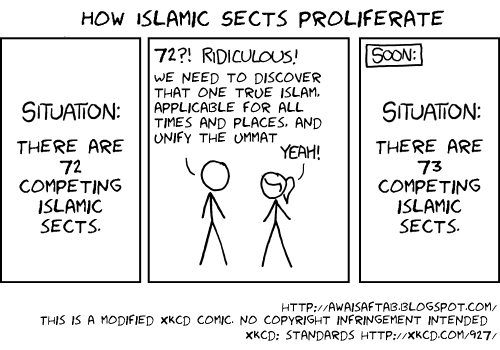
The problem is that violent sectarianism – as we’ve been hearing about by Pervez Hoodbhoy and so many other speakers – is so deeply enmeshed in Islam and its history, that while claiming that the “Muslim Ummah” is made up of a billion or more people and constitutes the “fastest growing religion” (a dubious claim), most Muslim sects actually don’t recognize large sections of that Ummah as Muslim in the first place! Besides the big Shia-Sunni split, there are multiple splits within those 2 groups, then there are the Ahmadis, and the Sufis, and sub-sects within those as well. And members of most of these groups will be quick to tell you that all those other groups don’t follow the “Real Islam”.
The Catholic Church and several other Christian denominations “excommunicated” people for centuries (and still do though much less intensely). Islam, in a way, democratized the practice of excommunication. This practice is called ‘Takfir’ in Arabic: any ordinary “Muslim” – not just clergy, but anyone who claims to be “Muslim” – can declare another person who claims to be “Muslim” a non-Muslim or a “Kafir”.
For most Muslims, being labeled a ‘kafir’ by another Muslim feels like one has committed a kind of treason to one’s family and community. Daesh and other Islamist terrorist groups rely on the doctrine of Takfir (calling somebody else a Kafir) as their ideological basis. This is how they justify – to themselves and to their new recruits – massacring not just non-Muslims, but also thousands of people who identify as “Muslim”, whether they are Sunni, Shia, Ahmadi, Kurd, or anyone else. Each group’s ever narrowing definition of “Muslim” (which is to say, ever narrowing definition of “human”) marks everyone else in the world as Kafir: a sub-human who doesn’t deserve the same rights. It is a terrible derogatory term, on par with any horrible racial slur used to dehumanize an entire group.
This is the paradox at the heart of religious identity politics and its liberal apologism. Do people have the right to self-identification? (Yes!) Do we accept that anyone who claims to be Muslim is, in fact, Muslim? (Err. Yes?) Anthropologist Talal Asad, from the City University of New York, writes in his essay Anthropology of Islam, “A Muslim’s beliefs about the beliefs and practices of others are his own beliefs.” This issue is part of most Muslims’ belief system: who is and isn’t a Muslim? What is a “real Muslim”? What is the “Real Islam”?
So, we are left with the dilemma faced by so many well-meaning liberals: that awkward situation of having to accommodate beliefs that are themselves unaccommodating, in the name of accommodating all beliefs.
As those who chose to leave Islam, Ex-Muslims are often seen as having devolved, having debased themselves to become a ‘kafir’: in other words, having betrayed their very humanity. This choice is naturally, and for a good reason, seen as a threat to the supremacist thinking promoted by Islamism that Islam is not only the best religion, but is the natural state of humanity, which is why some Muslims use the word ‘revert’ when referring to converts to Islam.
So it’s no wonder that people who leave Islam, whether they call themselves Ex-Muslim, apostate, or anything else, tend to face social ostracism, sometimes to the extreme. They tend to face isolation from family members, emotional blackmail, including alienation from younger siblings and their own children if they have them, and financial abuse. What kind of twisted, evil person voluntarily gives up his or her humanity?
Every Ex-Muslim has thought after they left Islam that they were the only one. With the Internet now, it is becoming much easier to find other like minded people, but the sense of isolation in new apostates is still strong, especially in their immediate surroundings, among their families, their neighborhoods, and their friends. Just yesterday, I met two siblings who had lived for years in the same household as closeted atheists, both thinking they were alone in their apostasy. And this situation is far from unique.
Every once in a while, we hear of an honour killing or a suicide. But death is only the extreme scenario. More often, many Ex-Muslims live with a steady barrage of microaggressions – everyday pressures to conform, to hide their lack of belief, to go through the motions , to wear a hijab, to marry a Muslim, and much more. I’ve known Ex-Muslims who have to pretend to fast, or actually remain hungry and thirsty for days against their will, because they live under the watchful eyes of religious family members. Many of the younger apostates are unable to be ‘out’ about their beliefs because they rely on their families for financial support, not to mention the emotional dependence ingrained into all of us as part of Muslim family structures.
The more Ex-Muslims speak up and reclaim the terms ‘Kafir’, ‘Murtad’, and with them, their right to be heard, their rights as humans to follow their own conscience without having to pretend, the more Islamists lose that ideological power that comes from what they see as their “divinely ordained” right to define who is and isn’t human.
One of the best and most efficient ways to stave off Islamism is to give platforms to diverse Ex-Muslim voices. Diluting the identity politics that is the lifeblood of Islamism is possible. Moderate Muslims often avoid supporting Ex-Muslims, perhaps out of fear of being called Kafir themselves. But more and more are realizing that we are not anti-Muslim. We may criticize Islam, like we do all religions, but we stand in solidarity with anyone, including Muslims, when they are being targeted out of hatred and xenophobia. Allowing the space for apostasy can give breathing room for variations and reformations within Islam as well. Islamists want us to believe that by leaving Islam, we lose our place as humans, and we lose our identities. But we don’t. What we actually lose is their hold on our definitions for ourselves. For us, Islamists no longer get to define what is and isn’t human. We think for ourselves. And that is what really, really scares them about us.
We Ex-Muslims tend to use LGBTQ lingo, because there are actually striking similarities among the lived experiences of both types of people, particularly the dehumanization and isolation they face within their own families and communities. Yesterday was “Coming Out Day”. I see this conference as a celebration for many Ex-Muslims who have come out to each other and to themselves. And those who will find inspiration in the days and conversations to come.
Thank you.

Connect with me on Twitter: @KiranOpal

Wednesday, March 27, 2019

Why it is easier to talk about bad sex


This article was copied from this link.


Why It’s Easier to Talk About Bad Sex

But pretty damn hard to come clean about the good stuff.

Just because I write a lot about sex, that doesn’t make me a sexpert. Don’t worry, I don’t consider myself an expert in anything although I often write about my own life experiences.

the image is taken from here

And just because I’ve written a lot about bad sex, that doesn’t mean I should be prohibited from writing about sex at all. Sometimes people make judgment about who's qualified to write about sex, but that gives me pause to wonder when a person should be allowed to write anything.
However, I can see why some confusion among readers happens. I do write an awful lot about “bad sex” and provide some social commentary upon what it means to me. As a result, some people jump to the conclusion that I am bad at sex. That I must not really like it. Or that I’ve never actually had the good stuff.
Frankly, I’ve probably had more bad sex than good, but also for good reason. I didn’t always know that I was allowed to say no. I expected very little (actually, far too little) from the men I dated. And I didn’t always know how to create or enforce otherwise strong boundaries in any of my relationships.
It recently occurred to me that I haven’t given good sex as much attention as I likely should. That’s when I realized that good sex is admittedly more challenging for me to write about.
I still battle "guilt" about premarital sex.
Even though I’m no longer a Christian or religious person by any stretch of the imagination, old habits die hard. Overcoming the guilt I was taught to associate with sex hasn’t been so easy to do.
I know I’m not alone in this one, but guilt does make it harder to talk about good sex, and it’s actually one of the biggest reasons I make a point to write about sex at all. And even though my stories about sex can’t please everybody, I am happy to know that my words are helping somebody work through their own sexual hangups.
But I’d be lying to say there’s no residual awkwardness, or that my face doesn’t glow a bit red when certain people read my more sensational stories. I survived the purity culture of the 90s, but I definitely didn’t get through it unscathed.
I was married for a good two-and-a-half years, yet the marriage went unconsummated because I had vaginismus. And then I never actually relaxed enough to have an orgasm until I was about 31-years-old. Guilt can do really weird things to your head and your body.
Talking about good sex feels much more personal.
Clearly, good sex is in the eye of the beholder. So no judgment, right?
But the thing is… writing about good sex winds up feeling much more… revealing. A helluva lot more intimate.
When I write about bad sex, I can usually laugh about it. And others can laugh about it along with me. As in, yes, it’s crazy that I have put up with some very bad behavior from men.
At least I can laugh about it now and enjoy the relief of finally knowing better.
But writing about good sex goes beyond the mistakes of my past. It delves into more hidden and vulnerable desires which other people can read and possibly judge or misinterpret.
Then there’s the issue of my fatness.
Ah, yes, I am also a fat woman in America. That means there is an inherent faction of readers who firmly believe I have no business writing about sex. Or even having it.
One time, I took a risk to write about how fat bodies are sensual bodies regardless of opinions to the contrary.
Of course, some folks felt I was rudely “taking them to task” and dictating who they should be attracted to. But I saw it more as opening people’s minds to the notion that sensuality is so much more than skin (or flesh) deep.
Of course, it would be disingenuous for me to say that I am completely untouched by brutal comments regarding my sexuality and fatness.
There are many different kinds of good sex.
Let’s be honest, there are wildly different definitions of good sex. Gender can even play a role in how we define the good and the bad. Sex in and of itself can be complicated, messy, and even awkwardoften due to the baggage that each person brings into the shared experience.
That’s not to say I’m not sex positive, because I am. I’m just very, very human. It’s taken a lot of effort to cross off my various sexual hangups. Again, I don’t believe I’m alone in that.
Within my entire sexual experience, I would say that the sex with only two or three of my partners was really good. Maybe even great, but… it’s also pretty damn complicated.
It’s complicated because you can have amazing sex within a shitty relationship. Partners can be attentive in the bedroom, but treat you like dirt in every other way. You can have good sex, but mixed feelings too.
Bad sex can improve upon better communication and more effort between partners. (Aka you talk about it.)
In my opinion, good sex can even be a mixed bag, in part because of the way a relationship morphs over time.
A while back, there was a partner who gave me nervous butterflies constantly. The first time we were intimate at all, I felt pressure for something to happen, despite the fact that he wasn’t pressuring me. I have nothing but good feelings for the guy and categorize our time together as good sex, despite my beginning awkwardness, and despite my having a hard time climaxing since I tend to lose my orgasm from time to time.
I’m demisexual, and yes, we can be kind of intense about sex.
Some people are really great at separating sex from a relationship. Not me. I am way too demisexual, which means I can’t even feel attraction to a man if I don’t also sense some esoteric, deeper connection.
That one’s tough for a lot of people to understand. Guys I’ve dated will say they get it, but that typically seems to be untrue when they’re pushing for sex and I’m explaining for the twentieth time that I’m not sure I feel that way about them.
That said, good sex deserves more attention.
I do plan to spend more time talking about good sex--as nebulous as that topic might be. I’ll still have plenty to say about bad sex and gender gaps, but I want to write more about the positive stuff too. Our culture won’t become more sex positive without every kind of awkward conversation about doing it.
Even though we’re apparently having much less of it for now.