Search This Blog

Showing posts with label movie review. Show all posts

Thursday, April 23, 2026

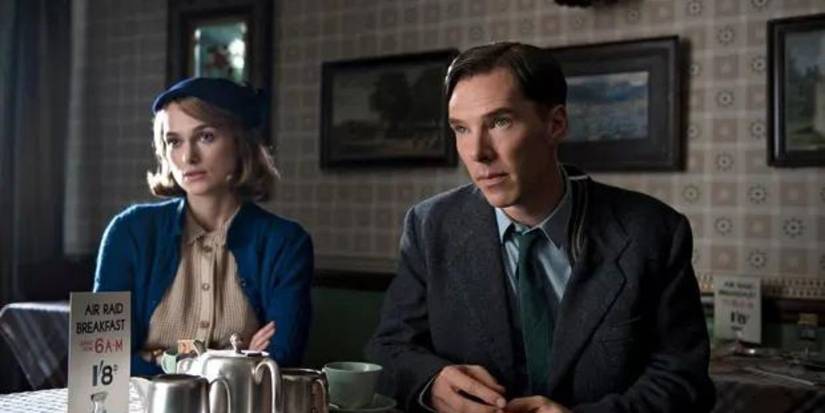
The Imitation Game

Alan Turing an Joan Clarke sitting at a table in The Imitation Game
Knightley and Cumberbatch in 'The Imitation Game'


In fact, I am not really into movies; therefore, in my entire life for almost 60 years, I don't watch a lot of movies. This became my excuse to say that just two days ago -- April 21 2026 -- I 'found' a movie entitled THE IMITATION GAME, which was released in 2014 when scrolling youtube. 2 actors playing there -- Benedict Cumberbatch and Keira Knightley -- attracted me more to watch it.


The beginning note appeared saying that the movie was based on a true story made me feel excited, I became more dumbfounded when finding out that Benedict played as Alan Turing, a mathematician who invented computer! (pardon me for being so 'late' to know and watch this movie! Lol) o my god. I remember the time when I let myself spend hours a day on one social media; some people mentioned Alan Turing's name as a whiz, some others despised him as being a gay. (FYI, this is in Indonesia.) this kinda useless 'debate' went on and on and on. People who love using this latest technology but despise homosexuality keep creating excuses to accept the fact that Turing was one important persona in inventing computer.


The first impression Turing -- or you can say Cumberbatch -- gave me in the beginning of the movie was that this man was really a smart cookie, a prodigy that was on par with Einstein! The way the movie illustrated Turing as a nerd who was not so social justified my idea that a genius was usually a nerd, despite the fact that some people say the real Turing was not that nerd as Turing in this movie.


The next impression was heart-breaking for me: when I knew that Turing was punished for his being homosexual by the British government. (Being a homosexual was considered a criminal in British law back then.) How the British government didn't appreciate Turing for what he had done -- to break the code of Enigma that resulted in the shorter period of the WW was almost impossible for me. The ability of Turing (and his co-workers) to decode Enigma -- that resulted in saving thousands of lives -- didn't help to save him from being injected with 'hormone therapy' to 'cure' his homosexuality. (so, in fact, homosexuality was analogous with crime or disease?)


13 years after Turing passing, the British government passed the Sexual Offences Act, decriminalizing homosexual acts in private between two consenting men over 21 in England and Wales.


In 2009 British Prime Minister Gordon Brown, speaking on behalf of the British government, publicly apologized for Turing's "utterly unfair" treatment.


46 years after the Sexual Offences Act passed, Queen Elizabeth II granted Turing aroyal pardon.


And just yesterday, in 2026, I happened to read a thread where (Indonesian) people still considered homosexuality a disease. More than a thousand likes on the thread, and hundreds of comments agreed with it. (sigh ~~)


PT56 13.53 23 April 2026


Alan Turing
Alan Turing


Tuesday, February 10, 2026

Grey Divorce


How well do you think you know your partner?


I have known this stuff  (people do not always know well their partners) since time immemorial for sure. Nevertheless many people do not consider it a kind of problem in a relationship. Some reasons for this, perhaps, because they believe that 'what has been united by God must stay the way it is' (for Christians?) and a kind of social pressure that 'you must be loyal to your spouse no matter what has happened in your marriage in order to be considered you are a good man/woman.' (This kind of social pressure does not only belong to women, does it?)


I was kinda appalled by this (again) when I accidentally 'found' a film entitled HOPE GAP. Edward and Grace who have been married for 29 years finally got separated. Is it only because for the past one year Edward has been seeing another woman?


Grace: "We have been married for 29 years!"

Edward: "I have tried (surviving in this marriage) for 29 years!"


I came to think that in fact Edward had realized much earlier that their marriage didn't run well, one thing that Grace didn't realize! However, Edward was a type of a man who could not say forward to his wife about how he felt. Grace, on the other way around, had been busy with her own way of thinking that everything was okay. The only thing that was not okay was Edward who could not balance her 'emotion'. Edward would rather be quiet than talk openly when things got strained between them. Perhaps because he realized that there was no use to talk to the dominant Grace?


(to some extent, this reminded me of my (first) marriage. My ex would rather be quiet than respond to me. The difference was: Edward left Grace, I divorced my ex. The reaction of my ex was somewhat similar to Grace's: refused to be separated.)


I am of opinion that I could blame our intellectual gap. Grace blamed Edward who chose to live with another woman.


In one conversation with Jamie, the son, Edward said he believed that Grace only loved the idea' of a man she invented in Edward, not the real Edward; he used to believe his (old) feeling toward Grace as love but he was wrong. They both never really loved each other as a couple.


N.B.:

You may read about grey divorce in this link.


MS48 - MS 58 15.10 10 February 2026


N.B. (2):

I am very much impressed with what Angela said to Grace, "prior to the separation, there were three unhappy people. now, there is only one." that statement seemed to be able to make Grace realize that no matter what, she has lost Edward. Edward would never come back to her.  (she really did not understand Edward though she claimed she loved him.)


Tuesday, March 22, 2022

THE READER


In fact this movie is a flash back to Michael's past experience when he was a teenager. He was 15 years old; the setting of time was around the second world war.


Michael was not feeling well when going back from school. He took a tram and couldn't stand his bad condition. After getting down from the tram, he vomited in front of Hannah's apartment. Hannah -- 30 years old back then -- was the conductor of the tram. Seeing his bad condition, Hannah helped him, brought him to her apartment and took care of him.


Several days later, Michael went to Hannah's apartment, brought her a bouquet of flowers to show gratitude. At that time, he saw Hannah getting dressed and attracted to her beauty and sex appeal. Realizing Michael's interest in her, Hannah even seduced innocent Michael. Since then on, they had discreet affair.


One interesting thing in their affair -- for me myself -- was when Hannah told Michael she was illiterate, and was very curious to know how it was like to be able to read books. Therefore, then Hannah set up a new rule: she asked Michael to read her a book before their lovemaking.


After some time, out of the blue, Hannah disappeared; leaving Michael deeply broken-hearted.


8 years later, Michael was a student of a law faculty. His professor asked him and some other students to attend Nazi trials. To his horror, Michael found that Hannah was one of defendants as she was a guard at Auschwitz; she was accused of allowing several hundred prisoners to burn to death locked inside a church. Among some defendants, Hannah was accused to be the guilty one because she was the one who signed the instruction letter. She defended herself that she just did what she was supposed to do as her job description but because she (was forced to) admit that she was the one who signed the letter, she could not avoid her punishment: life imprisonment.


Michael was in a dilemma. He knew that Hannah was illiterate, so if he helped to tell the court about it, he could save Hannah from her punishment. He didn't understand why Hannah didn't tell the court the truth that she was illiterate. However, Michael chose to stay quiet.


******


Many years later, Michael, a widow with one child, still could not erase his past memory with Hannah. He kept his feeling guilty for years; this made him unable to have a good relationship with other women. To reduce his feeling guilty, he started to record his own voice while reading books, and sent the tapes and the books he read to the prison where Hannah was imprisoned. He just dropped the tapes and the books without meeting Hannah. He was sure that Hannah would know who the sender was.


Around 2 weeks before Hannah was free, Michael came to the prison, to meet her in person. The meeting was awkward. Hannah was a bit touched by Michael's attention to him, but she knew that Michael still kept a certain distance from her. Michael was described as doubtful what he was about to do. Their past affair formed Michael's character as someone who was always uncertain in facing women. (just my opinion, though.)


In that occasion, Michael told Hannah that he had prepared a place for Hannah after she was released from the prison.


On the day when Hannah ended her life imprisonment, Michael came to pick her up; only to find out that Hannah committed suicide.


My comment:

Why did Michael become so annoyingly coward? And I was very heart-broken when finding out that Hannah committed suicide. She survived from her long life imprisonment, only to end her own life on her free day.


Awards:


Kate Winslet (Hannah Schmitz) got Oscar for her best performance in a leading role

The movie got the best motion picture of the year


Tuesday, February 07, 2012

The Countess


THE COUNTESS
(A movie based on the life of Erzebet Bathory 1560-1614)

“History is a tale told by the victors. Barbaric warriors, mad kings, and greedy traitors. Maybe most of our histories are made of fables fabricated by those glorious victors. ” 

Istvan Thurzo in “The Countess” the movie.

Elizabeth (Erzebet) Bathory is very popular as one cruelest woman in the history. She was said to have murdered more or less 650 women “only” because she was greedy of youth and beauty. One accident that was caused by the splashes of one maid’s blood to her face – that she thought it had remarkable effect to make her skin look younger, softer, and fresher – triggered this heartless cruel act of hers.

Some articles in the internet do not explain what caused her greed of youth and beauty. However, the movie “The Countess” illustrated it. At her 39 years of age, Erzebet fell in love with a gorgeous man who was 18 years younger. His name was Istvan. They both were depicted to very passionately love each other. However, Istvan’s father – Gyorgy Thurzo who also wanted to marry Erzebet for power and wealth, not for love – tried his best to stop their passionate love, accusing that Erzebet only played his son’s heart. Meanwhile, Erzebeth’s most trusted ‘accomplice’ – Darvulia – also doubted Istvan’s true love. “Young people easily change their minds. He will find another woman soon,” said Darvulia to Erzebet.


Istvan’s disappearance without letting her know what was going on and Darvulia’s remarks made the tough Erzebet relent. She blamed her age. She believed if only she were younger, Istvan would not leave her. Therefore, when finding out that the blood of young virgin girls could make her skin look younger and softer, Erzebet started to be thirsty of those unfortunate girls’ blood.

As a child, Erzebet was raised to have cruel and merciless heart. Since she was very young, she was ‘trained’ to see merciless treatment toward poor peasants who happened to do crimes. When she was a teenager, she fell in love with a boy coming from a poor peasant family. As a result, the boy was tortured to death before Erzebet’s own eyes, while the baby she had from the boy was taken away directly after Erzebet gave birth.

Erzebet married the Hungarian baron Franz (Ferenc) Nadasdy at 15 – their marriage had been planned since Erzebet was born – and had three children from him. Nadasdy died after he returned from a war against the Turk. As a great warrior, from the war he gained a lot of wealth that Erzebet inherited after his death. Despite the fact that in that era a woman could not become a proprietor of wealth, the King could not object it since he had a lot of debt to Erzebet after the Turkish wars.

Erzebet’s murderous act was ‘safe’ until her accomplices started arresting daughters of lesser nobility. Gyorgy Thurzo – aiming to get more power and wealth – reported to the King about it while convincing him that by taking Erzebet to court would make his debt to the widow of Nadasdy gone. Conspiracy.

History is indeed written by the victors?

Erzebet is a loser then. History has made her notorious.

LG 15.36 040212

Friday, November 25, 2011

The Burning Plain

the poster of the movie

Is a woman still a woman without her breasts?

Apparently this case – breast cancer – triggered an affair between Gina (Kim Basinger) and Nick Martinez (Joaquim de Almeida); this affair then made them die in a fiery explosion in a trailer where they usually had dates. The death of these two people who were deeply in love made their kids lose their mother (Gina had 4 children) and father (Nick had 2 children).

Gina
If the reason is clear why Gina was involved in an affair with Nick – a married man – the movie doesn’t give clear illustration why Nick did that. Although Gina lost her left breast due to cancer, Nick loved her passionately; always gave her warm sensation and sexual satisfaction every time they dated. This was absolutely very contradictory to Gina’s husband who lost his passion toward his wife. Doesn’t everybody deserve to have and enjoy wonderful lovemaking with someone they love? Someone who has successfully made them accepted and loved just the way they are?

Without Gina and Nick’s knowing, Mariana (Jennifer Lawrence) – Gina’s eldest daughter – knew their affair. She even found out the place where they dated: a trailer located in a very spacious open plain. This made Mariana lose her respect toward her mother. In order to make Gina ‘come back’ to be a loyal wife to her father and a caring mother to the children, Mariana did something to stop the affair between her mother and Nick that accidentally killed them both.

young Mariana and Santiago

Deeply devastated due to the accident that made the two families hated each other, Mariana surprisingly accepted Santiago’s invitation – one son of Nick – to have a date. Not long after that, Mariana and Santiago (J.D. Pardo) even fell in love with each other and ‘copied’ what their parents did: having a forbidden love affair. When Mariana’s father found out this affair, he would kill Santiago. However, before this happened, Mariana asked Santiago to run away together. They went to Mexico to continue their life.

Mariana gave birth to a daughter that in fact made her very worried if the daughter would grow up to be like her. To avoid that, she even left the two-day baby girl with her dad.

In order to leave her dark past, Mariana changed her name to be Sylvia (Charlize Theron). She lived an economically successful life with her restaurant. Obviously, her beauty charmed many men so she had a lot of one-night-stand dates. She did not want to have one steady boyfriend because she was even worried to be heart-broken. She did not want to walk in her mother’s path either – let’s say by having a long-lasting relationship with John, one employee in the restaurant, who was married.

Sylvia in one attempt to commit suicide
Despite her success, the dark past kept following her: killing her mother and her boyfriend, breaking her father’s heart by having an affair with Santiago, leaving the family to live together with Santiago until she left her baby. No wonder if once in a while Sylvia looked depressed and wanted to commit suicide.

Meanwhile, in Mexico, Santiago got a very serious accident. Worried that something bad would take his life, Santiago asked his friend, Carlos to look for Mariana in order that Mariana (alias Sylvia) would take care of their only child, Maria.

Could Carlos find Mariana? Would he successfully beg her to come back to Santiago, especially to take care of Maria, the daughter that she left for more than a decade?

Maria, the daughter of Mariana and Santiago

Additional note:

It is quite interesting to pay attention to the ‘affair’ between Sylvia (Charlize Theron) and John (John Corbett), her own workmate. John who was married looked so possessive and jealous every time he saw Sylvia intimate with a guy. One time when she was dating one customer of her restaurant, John could not control himself. He embarrassed Sylvia by scolding her, in front of that guy, “Is that what you do? Fuck any guy you wanna fuck? And then just go?”

Sylvia responded, “Don’t mess up with my life, John. You don’t have me! Just overcome your own problem with your wife!”

Nevertheless, when one time Sylvia ‘challenged’ him to run away together, to leave everything they owned at that time, John refused. It proved that John was not different from any other man who dated Sylvia: only to have fun. The difference was if other men didn’t show exaggerating possessive character, John annoyingly did.

GL7 10.30 251111


Sunday, October 17, 2010

Sex and the City 2 (the movie)


There are several parts in this movie that attracted my attention most:
  1. Carrie's so-called 'scandal' to kiss Aidan
  2. Miranda's decision to quit from her job
  3. the private conversation between Miranda and Charlotte
  4. the way the scriptwriter ended the story

CARRIE'S kissing Aidan

I remember in one serial of SATC where Carrie and Big were not a couple, they had a date in California, when Carrie attended her first book reading. Big seemed so guilty toward Carrie when reading Carrie's first book entitled SEX AND THE CITY because reading one article to another article to another in fact made Big realize how he hurt Carrie's feeling. Carrie -- who had been horny since leaving New York and expecting to have sex with Big (Carrie chose to do it with her ex boyfriend rather than with any other guy, a stranger) -- thought that the book became her big obstacle to appease her lust. So when Big refused to do it because he was worried if he would hurt her more, Carrie said, "Oh come on, it it JUST SEX." Big responded, "But in your book you said, "it is NOT JUST sex ..."

I did not think that Carrie would be that troubled due to the kiss she had with Aidan, although she did it accidentally because they accidentally met each other in one traditional market in Abu Dhabi, more than 6000 miles away from New York, although their dinner was not done accidentally. Carrie could have refused the dinner invitation, but she did come to Aidan's hotel.


After the short 'accident' kiss, Carrie rushed back to her hotel and told her best girl friends. Miranda and Charlotte who were still having a heart-to-heart conversation about their being a mother, were just speechless, could not say a word. They were too shocked to hear it or to see Carrie's troubled facial expression after doing it? LOL. (joking ...) While Samantha who was still having relaxing bath to prepare herself before dating a hot Arab man, 'easily' said, "Don't tell Big! It is JUST A KISS." when Carrie said that she had to 'repent' by telling Big the truth because she did not want to have any secret between Big and her. It is sooo Samantha. LOL.

Carrie eventually told Big. And he was shocked.

MIRANDA's decision to quit from her job

Although I repetitively said (or wrote) in my blog about the definition of being a feminist is to have her own authority to make any decision -- for example to work professionally or to be a full housewife -- Miranda's decision surprised me.

I love Aidan's remark on Carrie, "You are anything but being traditional."

I think this remark was also appropriate for Miranda (as well as Samantha). I would not think that Miranda would quit to be able to attend a ceremony at Brady's school to make him happy.

MIRANDA AND CHARLOTTE's private conversation

This part is very feminist. LOL. or you can say humane. :) Both Miranda and Charlotte were mothers. So different from Carrie and Samantha, Miranda and Charlotte's days were full of taking care of babies. Miranda got Brady 'accidentally' because she did not plan to get pregnant. Charlotte was on the way around. Charlotte and Harry, her husband, tried hard to get a baby. They adopted their first baby, while the second one was their own.

"I really want to be a mother but then when having two babies sometimes I want to get rid of them. I need some private time to be on my own!" Charlotte said.

"That is very natural, don't feel guilty for that. I experience that too after I decided to quit from my job." Miranda agreed.

Absolutely I agree with these two good friends. Everyone is entitled to have some private time to be themselves, to do anything they want, such as to be with their good friends. In this case, it means I also agree with Big's idea to sometimes live separately from Carrie, although it does not necessarily mean they do it regularly, let's say like Big's idea, to live separately for two days EVERY WEEK.

One surprising thing from the private conversation was when Charlotte -- the most traditional one of the four -- said that she was even more worried to lose her nanny -- she was outstandingly a very good one, and her babies love her -- rather than Harry. Erin was illustrated as a very sexy woman with big boobs and never wore bra! Charlotte was somewhat offended when Samantha said that probably Harry would get attracted to Erin and cheat Charlotte. And Charlotte several times saw with her own eyes how Harry got stuck to look at Erin's boobs in several occasions.


THE ENDING

I must say that I was disappointed to see how the scriptwriter ended each problem, especially Charlotte's problem with her nanny, Erin. The writer made Erin as a lesbian so that she would not get attracted to Harry at all. Why that simple? :-( (So, what do you expect Nana? Just like one sinetron in Indonesia? Despite the hot temptation, as a pious (probably?) Jew, Harry tried hard not to get attracted by Erin? LOL. And he successfully passed it. LOL.

That Big forgave Carrie for kissing Aidan was not a surprise. It was JUST a kiss and both Big and Carrie were grown-ups. The silly thing (seemed like teenagers anyway for me) was when Big asked Carrie to vow, "I will not kiss any other man but my husband." LOL.

That Miranda then found another job was very predictable.

And Samantha got hot and wild sex with that Arab guy was not a surprise. Samantha seemed to always get the same role, a very hot one. I adore her because I am not sure if I can be as sexually open as she is. LOL.

PT56 19.19 171010

Monday, May 10, 2010

The Life Before Her Eyes


“The power of visualization can shape one’s own future.”

This movie – The Life Before Her Eyes – is based on the thesis above. Diana, Evan Rachel Wood, is imagining what her future life would be like after she listened to the speech given by one professor at her school, Paul McFee.

Diana is an imaginative, impetuous, wild teenager. After listening to McFee’s speech, Diana starts to visualize her future life. She is married to Professor Paul McFee, having one daughter, Emma, and she works as an art teacher. Contradictory from her life as a wild teenager, she visualizes her future life as a very ‘common’ woman in general, in a very common marriage life.

However, Diana cannot prove the thesis stated by the professor, that she can shape her own future by having strong visualization – that she would lead a very common life, like many other women on the globe. Diana is tragically killed in a Columbine-like shooting incident at her school. When the killing happens, Diana is in a restroom with her best friend, Maureen. After shooting many people around the school, Michael, the shooter, enters the restroom where Diana and Maureen tensely wait for their turn. Michael forces the two girls to choose which one to be killed. Maureen offers herself first. Michael then asks Diana why not her. She acquiesces and asks to be killed. She is then shot and dies; leaving Maureen shocked.

The interesting thing from the visualization, in my opinion, is that Diana visualizes herself as a very ‘common’ woman, a married woman, having a kid, working as a teacher, and her loving husband (eventually) is involved in an affair with a younger woman. Diana’s life as a teenager is different from Maureen who is depicted as a conservative girl. Diana exposes her curiosity in drugs and sex by having a relationship with a guy who likes her because she is a ‘courageous’ girl. The guy does not want to be responsible, though, after Diana gets pregnant, and let her solve the problem by going to the hospital herself to get abortion.

Nevertheless, Diana visualizes her daughter, Emma as having a personality trait like her. This makes herself feels very concerned.

Anyway, when finally Michael chooses to kill her, instead of Maureen, from her facial expression, one can see that Diana is depicted to die peacefully. She has saved her best friend’s life.

PT56 11.15 090510

Sunday, November 01, 2009

The Pursuit of Happyness


“We hold these truths to be self-evident that all men are created equal that they are endowed by their Creator with inherent and inalienable rights; that among these are life, liberty, and the pursuit of happiness, …”
(The Declaration of Independence by Thomas Jefferson)


Obviously Chris Gardner, the main character in the movie entitled “The Pursuit of Happyness”, a film by Gabriele Muccino was really obsessed by what Jefferson wrote—that all men are endowed the right to pursue happiness. The movie inspired by a true story has Will Smith as Chris Gardner, Thandie Newton as Linda, and Jaden Christopher Syre Smith as Christopher, their son.

When watching the movie, I was touched by the big belief of Gardner that he was really endowed that right. Everybody deserves to be happy and everybody has their own way to pursue their happiness, no matter their color, the gender, the ethnic group, the religion, etc. Therefore, everybody must strive to reach it.

Linda also believes in it. When she thinks that her husband cannot make her happy in their marriage, she has her own way to pursue her own happiness—by leaving her husband whom she thinks impotent to look for money. She is tired of being poor, having to work hard—double shift—to pay the bills while in the beginning of their marriage, she is promised happiness by her husband; happiness that she thinks without financial constraint, without her having to work double shift.

When leaving her husband, she takes Christopher with her. In America, children under 18 years old are to follow the mother when the parents are separated or divorced. However, when the following morning Chris takes Christopher from the day care, Linda doesn’t complain a lot. She does understand that Chris is a good father, only he is not really good in looking for money. That’s why when she leaves for New York to start a new life—her sister’s boyfriend opens a restaurant, Linda expects a better future there—she doesn’t mind leaving Christopher with his dad although she feels very unhappy.

Big determination of Chris to pursue his happiness—always remember what Jefferson writes in the Declaration of Independence—makes Chris do his best to reach his dream, not only for himself of course, but the more important thing is his only son. This is somewhat the reflection of his own life where he met his father for the first time when he was 28 years old. He feels very unhappy for that, and this makes him determined that if he has children, his children would know who their father is.

The story happened during the last two decades of the twentieth century. I am wondering whether Chris would get that position in the brokerage firm of Dean Witter—that miraculously changed his life—if the story had happened when Jim Crow Law still haunted America?

PT56 21.28 220807

Sunday, August 30, 2009

Anne Frank


I just finished watching ANNE FRANK the movie. (Better late than never, do you agree?)
Some sentences and scenes of the movie were adapted from Anne Frank’s Diary. Some others, I think, were based on what happened in the reality of the second world war as well as the crazy troops of Nazi’s way to treat the Jewish. Some others, perhaps, were based on the imagination of the scriptwriter. You know, even though there is writing ‘based on the true story’ at the beginning of a movie, it cannot be avoided to include some imaginary parts.
People all know that Anne Frank died in one concentration camp due to typhus. This diseases attacked many ‘prisoners’ in the camp due to very limited food and drink as well as unhygienic condition and clothing.
Still my heart was broken when watching the parts when Margot, Anne’s sister, looked so terribly ill; when Anne’s food was stolen by another prisoner; when Anne was unhappy thinking that she would live all alone if Margot died. Before that, she heard that her dad died in the ‘gas room’, and her mom died too because of something else.
I even still expected that in the movie, Anne would survive.
Or at least, the movie would not have scenes where Anne died. I did not want to come to that part.
And the movie really did not show the part when Anne died. I felt a bit relieved. I did not need to be mourning uselessly.


However, I still felt blue after that. When reading Anne Frank’s diary I knew that her dad survived. He himself had his daughter’s diary published, to tell the world the cruelty as well as the inhumanity of Nazi. When I watched the scene of Otto Frank collapsed due to very deep sadness knowing his daughters died in the camp, I almost could feel the similar sadness.
If only Anne had known that her beloved Pim still survived, perhaps she would have tried hard to struggle to survive too.

PT56 22.52 290809

Thursday, November 06, 2008

Into the Wild


This movie is based on Jon Krakauer’s book that tells us about the true story of Christopher Johnson MacCandless who was born on February 12, 1968 and died on August 18, 1992. Getting very disappointed by his own parents, Chris (Emile Hirsch) left them and his younger sister, Carine, (Jena Malone) as well after graduating from Emory College, where he studied only to make his parents happy, and not to pursue his own ideal. The disappointment to his parents was supported by his sickness to hypocrite society. This made him leave the crowd of people and go INTO THE WILD.
Some favorite scenes and conversations of mine in the movie are:

“Some people feel like they don’t deserve love. They walk away quietly to the empty space trying to close the gaps with the past.”

Apparently Chris talked about himself; he left his family since his parents’ problematic marriage and their trying to cover it from public as well as from the children made him label the parents big hypocrites. By saying the aforementioned statement, he realized that his parents loved him. However, his deep disappointment toward them made him feel he did not deserve the love. Therefore, he disappeared quietly from his parents’ life. He was pursuing his own happiness in the wild. He did not use the name his parents gave, and named himself as Alexander Supertramp; he even simply told some people he met during his journey that he did not have family.
Hypocrisy in society has been one mainstream topic in my blog. Examples: people who let themselves trapped in a loveless marriage only because they live in marriage-oriented society; many in that kind of marriage, women become the main victims (just like what is illustrated in this movie), then the children. People (mainly women) who think that they are luckier since they find men who are willing to marry them and feel sorry for single (moreover old maids) women, while in fact deep down in their hearts they envy those free women. People who have children not because they love having offspring but only for their own pride and selfishness.

“… get rid of this sick society. Why people, every fucking person is so bad to other people, so fucking awful. It doesn’t make sense to me; judgment, control, all that whole spectrum…”

What happened to Chris’ parents—to be hypocrites, Chris said—was also for the sake of judgment from society—to be considered happy and romantic family while in fact inside, Billie, the mother was bruised. (Why do women always become victims?)
Some people feel like they have full rights to make judgment to other people, to say what is good what is bad using their own eyes, without trying to view things from different point of view.

Tuesday, September 16, 2008

Saved!, Juno, Gilmore Girls


A coin has two sides.

Just like a movie has many interpretations, not only two.

I plan to watch JUNO with my students this Monday. I have watched this movie with another class before, around a month ago, and I think this movie is quite ‘safe’ to be watched by teenagers: there is no vulgar scene, although the story is about a sixteen-year old teenager who gets pregnant outside the wedlock. I opine that the script writer as well as the producer of this movie wanted to give an alternative to teenagers how to face unwanted pregnancy; and to parents a kind of suggestion how about to stand together with the pregnant kid, to be supportive with the kid’s choice, instead of just blaming her without showing any comforting response, without realizing that sometimes female teenagers get pregnant not merely due to their own mistakes—such as accusation to have low moral because having sex out of a wedlock—but can also be engendered by the parents who don’t give enough attention, or too much controlling.

Saved!, Juno, Gilmore Girls

In this article, I want to compare three movies that have similar cases: SAVED!, JUNO, and one serial GILMORE GIRLS. They all have the similar topic: a sixteen-year-old girl who got pregnant outside the wedlock. Nevertheless, the cause of the pregnancy is different. The way to handle the case is different too.

SAVED! was produced in 2003/2004. This movie has very strong Christian teachings as the background. Mary, the leading character, got pregnant because she wanted to “save” his boyfriend who admitted that he was a gay in a telling-secret-under-the-water game. Feeling shocked, and with her head crashed something hard when she was about to go out of the pool, Mary saw a vision of Jesus coming to her, telling her that she was chosen to ‘save’ Dean (from being sinfully homosexual). Being able to make Dean enjoy their lovemaking, Mary thought she was successful to “cure” his ‘psychological/mental disease’. Therefore, she was very disappointed when knowing that Dean’s parents still sent him to Mercy House, a kind of rehabilitation to ‘solve’ any kinds of problems; such as addiction to drugs, homosexuality, until girls getting pregnant outside the wedlock. She felt cheated by Jesus’ vision coming to her.

JUNO was produced in 2007. The cause of Juno to get pregnant was merely she was curious to know what sex was like. ‘Playing’ something she didn’t know with one good friend, Paulie Bleeker rewarded her unwanted pregnancy.

GILMORE GIRLS was produced in 2004/2005. Lorelai Gilmore got pregnant when she was 16 years old merely because she wanted to rebel her controlling parents, especially her mother, who never gave her freedom to be herself. She always felt strangled in her parents’ luxurious house. Meanwhile, her teenage boyfriend, Chris, did that to get rid of his parents’ obligation to continue his study at Yale because he didn’t feel sure to be able to do that.

The solution to face the unwanted pregnancy is different. Mary, at SAVED! kept it secret, trying to hide her pregnancy She even did not tell Dean about it, not to her mother either. With help of her two schoolmates, Cassandra and Roland, she tried her best to hide her swollen belly under some special clothes. In another word, it can be concluded that Mary decided to keep her baby, although at the very beginning she was thinking of abortion.

At Gilmore Girls—as people can easily guess, because this serial focuses on the very intimate, best-friend-like relation between the mother and daughter—Lorelai decided to keep her baby too, but by leaving her parents’ home and doing her best to survive, as well as raising her daughter. She refused Chris’ offer to marry him because she thought both of them were not ready yet to live together in a marriage, moreover she knew very well that Chris was not psychologically and financially mature yet. This would just make the marriage not work well that possibly would just ruin the relationship of three of them—Lorelai, Chris, and Rory, their daughter, especially Rory’s mental development.
At JUNO, a bit similar to SAVED!, Juno was thinking of terminating her pregnancy too. However, then, she got a very brilliant idea, to find a couple of husband and wife who wanted to have a baby very much. She got one. The difference from SAVED was that Juno didn’t try to hide her pregnancy from her parents as well as her schoolmates. Bleeker, the father of the baby-to-be knew too the result of their ‘playing game’.

None of the three movies gave solution to marry the sixteen-year-old girl with the boy with whom they had sex, or with any other guy who was willing to “save” the good name of the family, a typical solution that usually happens in Indonesia.


Solution in Saved!, Juno, Gilmore Girls


SAVED! The failure of Mary to ‘cure’ Dean to me means that the producer as well as the script writer wants to tell the viewers that some people indeed were born to be homosexual, not because of the influence of wrong socialization. Before Dean told Mary about his secret—being a gay—he was involved in a Christian community, dedicated his life following Jesus’ steps. Any celestial religion will consider homosexuals sinful therefore they must be ‘saved’. In fact, Dean eventually had to give in his innate call.

Mary—who was involved in the same Christian community as Dean—was excited to be ‘chosen’ to help cure her boyfriend with the Jesus vision inside the pool. However, after she ‘sacrificed’ by having sex with Dean, Dean was still a gay. Furthermore, she seemed to be ‘punished’ by God to have sex outside the wedlock with the unwanted pregnancy. This ‘accident’ made her lose her strong belief that people would always find solution in religious teachings blindly, without using their common sense. Eventually, her mother accepted the fact that Mary got a baby; she did not need to send Mary to Mercy House because Mary was not a problematic teenager only because she was pregnant outside the wedlock. Mary needed the support of her mother to live her life much more strongly than to be sent to that kind of rehabilitation center which in fact did not really help the ‘victims’.

JUNO. Juno had decided to give away her baby to a couple when she told her parents about her pregnancy. Feeling shocked, but trying to hide it, the parents showed a strong support to Juno’s decision. The father—worried if Juno would be cheated because she was just a kid—accompanied Juno when meeting the couple who would adopt her baby. The mother protected Juno’s mental condition when people accused her a problematic teenager with her unwanted pregnancy. Juno expected that she would continue her life ‘normally’ (read  just like any other teenagers who didn’t get similar accidents) after she delivered her baby.

GILMORE GIRLS. Lorelai decided to run away from home, to deliver her baby, and to raise her using her own way—having intimate relationship with the baby, open communication, without ‘you’ve-got-to-listen-to-me-coz-I’m-your-mother’ trait toward Rory, a way to raise up a baby Lorelai believed would work much better than just controlling. By doing so, she believed that Rory would not end up getting unwanted pregnancy at a very young age.


Multi-interpretations


Especially the two movies above—Saved! and Juno—some people around me opined that the movies even encouraged teenagers to ‘play’ with sex because when they accidentally got pregnant, their parents would even support them and didn’t punish them anything, not even to scold them. (This reminded me of one article in a local newspaper stating that in the movie of BERBAGI SUAMI—LOVE FOR SHARE in English—Nia Dinata wanted to encourage men to be polygamous.)

I have never invited my students to watch SAVED! so that I don’t get any input yet from my teenage students. However, in JUNO, my teenage students could see the complicated things Juno had to undergo, the insecurity a teenage girl had to face in their daily life when getting unwanted pregnancy. This obviously will NOT encourage them to get similar problem, moreover if their parents punish them for embarrassing their ‘good name’ by getting pregnant outside the wedlock.

Conclusion

A movie indeed can be interpreted from different points of views. When showing a movie about teenagers’ life, we as parents/teachers are supposed to accompany the teenagers and then have a live and open discussion to come up to a beneficial interpretation for both sides.

PT56 11.54 140908
Monday, May 19, 2008

Freedom Writers 2


the pic was taken from here

After writing the result of the discussion in my class on FREEDOM WRITERS, in this article I will write what I like most from this movie.

Erin Gruwell is always the most conspicuous character. She really did her very best for her students although being a teacher at Wilson High School didn’t give her much money. Her own father, Steve Gruwell, who inspired her to treat others as well as she could, without looking at the different ethnic groups (from Steve’s involvement in the civil right movement), praised his daughter as a gifted person. I do appreciate her willingness to do two other part time jobs to make her earn more money where she used the money to provide facilities her students needed, especially books, and some other experiences they got from the trips they did out of town. The trips as well as the books opened her student’s awareness that there was a different kind of life beyond their own hard life. She opined that assigning her students to read DIARY OF ANNE FRANK would make them realize that they were not the only one to suffer from racial discrimination. Living a life as a gang member would even make their life more chaotic.

Among Erin’s students (I noted down eight of them, Eva, Marcus, Andre, Jamal, Cindy, Tito, Gloria, and Ben), I was very interested in Eva and Marcus. Eva easily attracted my attention since her life was portrayed at the very beginning of the movie. Her father raised her to believe in “Don’t go against your own people, your own blood.” Since she was a kid, she already got to know the racial ‘principle’ in America that the Latino people “are less than the white”. She grew up hating the white since the white cops imprisoned her father although her father was innocent.

Eva amazingly controlled herself well (to show that she was a very careful person, she didn’t easily like other people, moreover if they were white) while her classmates already showed their attraction toward Erin. Her disappointment when finding out that Anne Frank died was resulted from her big dream that Anne Frank, as the symbol of resistance, had to survive. She viewed herself as in the same shoes as Anne in the past. When Anne died, would she have to die too?

Eventually, Eva made a big change when she showed her courage by telling the truth in the court. She decided to do this by herself in spite of the fact that her parents as well as her Latino community asked her to protect Paco. This “seemingly small” step was expected to open people’s eyes to tell the truth so that they would do the same thing.

the pic was taken from here

Marcus also stole my attention. His rebellious character came to an end in Erin’s way of teaching. Erin successfully made him realize that education would really make a big change in his life. Going back to his family’s house showed his seriousness to alter his way of life besides studying seriously.
My favorite scene in the movie is the discussion between Erin and Scott, her husband, before he left the house. When Scott asked her to choose between the class and him, Erin came to her realization that what she was looking for in her life was to make her life meaningful by helping her students get rid of their hard life as gang members where they would oftentimes get involved in racial tensions. Her dedication to her job gave her a much greater satisfaction as well as happiness than to dedicate her life to her husband. ‘Helping’ more people to live decently gave her life more senses than just ‘helping’ one person—her husband.

This reminded me of one character in T.S. Eliot’s play “The Cocktail Party”, Celia. Celia who didn’t find what she was looking for in her relationship with Edward realized that she wanted to dedicate her life to human beings, not just one person, Edward, who happened to be married to Lavinia. This awareness—that what she was pursuing in her life was to dedicate her life to God by taking care of human beings—made her decide to go on a missionary.

Happiness in someone’s life—especially in women’s lives—is not necessarily always related to marriage life. When some women find deep happiness in dedicating their life to their husband and children, some other women possibly find it in different ways. Erin chose her students because that was her call. Btw, luckily Erin didn’t live in Indonesia where women get praised as “true and honorable women” only via marriage, especially by dedicating their life to their husband. Erin would get ‘bitch’ label since she ignored her husband, and chose her students instead. People would say that Erin just cared for her own happiness.

Another part of the conversation between Erin and Scott that attracted me was as follow:

“Why can’t you stand by me, and be a part of it, the way a wife supports her husband?” asked Erin to Scott.
“Because I cannot be your wife,” answered Scott.

The above exchange has always been my favorite dialog in the movie. Scott—or patriarchal men in general—would feel impotent when realizing that his wife was more successful than they were. This also apparently would hurt men’s ego.

Scott had shown his disappointment when Erin had the second part time job at Mariott hotel during weekend. “You even didn’t ask me,” was his first complaint. His second complaint was, “Everyone knows you can do anything!” He showed his being inferior in front of his smart wife since he lost his spirit to pursue his architect degree.

In patriarchal culture, men are always welcome to work hard, they even will get appreciation from society as good husbands. However, when women do that, they will even get mockery and they will be considered to oppose their destiny to be domestic creature, because they don’t do household chores as they “are created”. So, instead of getting appreciation because she had dedicated her life for her “unfortunate” students, Erin would get disapproval from society.

To end this writing, I want to cite my own idea of being a feminist: women are free to choose what kind of life they want. I do appreciate Erin’s choice to make her life more meaningful by dedicating her life to her job and deserting her marriage life. In our life we often come to time when we have to make a choice. Erin has absolutely made the best choice, to help more people (her students) than just one spoiled man (her husband).

PT56 16.10 180508

Freedom Writers 1


the pic was taken from here 


On Saturday 17 May 2008 I invited my class to watch FREEDOM WRITERS. The class consisted of 15 students, 4 guys and 11 girls, and all of them are college students. Before watching the movie, I gave three questions to be discussed afterwards:


  • Which character attracts you most? Why?
  • Which scene in the movie attracts you most? Why?
  • What do you think of the moral lesson conveyed by the movie?


For the first question, since Erin Gruwell has always been chosen by my students (when I invited some other classes to watch this movie), I asked the students in this class to pay more attention to the students in Gruwell’s class.

In short, Freedom Writers portrays the struggle of the new teacher, Erin Gruwell, to make her students—that mostly have been involved in gang life, violence, killing, drugs, etc—realize that education is the most important aspect in their life if they want to make a change to their lives.

Erin and Marcus
the pic was taken from here

For the first question, 8 students chose Marcus to be the most attractive character. They had a similar reason for that: they considered Marcus the most successful to make a change in his life. He left his family to get involved in street life as gang member because he thought it was the only way to show ‘tolerance’ to other African American people who had always been marginalized. In one long discussion/debate between Erin and the class (spurred by one student’s cartoon to ridicule Black people), one can find out how Marcus viewed his life: he felt like a hero when he showed tolerance to the sufferings of other African American people who happened to live on the street. He opined that if he got killed in a racial discrimination, he would get respect from his ‘community’. “We live in a war everyday,” he said to Erin. However, after he got enlightened by Erin, he realized that living on the street by joining gang life to survive was not right. Therefore he decided to come home and show his family that he changed. He proved that by studying seriously and graduating from high school.

Eva Benita
the pic was taken from here
Meanwhile 6 students chose Eva Benita as someone who made a great change in her life. Eva was raised by a father who believed that the white always marginalized the other ethnic groups. No wonder if Eva hated Erin who happened to be white. However, eventually Eva realized that not all white people were like what her father described. Erin who introduced the students to the Holocaust disaster—as an analogy to the kind of life her students had—successfully made Eva break what her father always taught her, “Don’t go against your own people!” In the court, Eva told the judge the truth about one accident where she was the crime witness. Although Eva had to risk being hated by her own father and Latino community, Eva daringly did what she thought it was the right thing to do. She must have been inspired by what Mip Gies did, the woman who help hide Anne Frank during the Holocaust.

Ben Samuel
the pic was taken from here

One student chose Ben Samuel, the only white student in Erin’s class. Outside the classroom, the white were the majority while inside the class, Ben was the minority. If at the very beginning Ben showed his restlessness to be in that class, felt very insecure among the Cambodian, Latino and Black students, eventually Ben stayed put in the class and behaved like one member of a big family consisting of various ethnic groups comfortably.

To discuss the three questions, I divided the class into four groups. For the second question, the first groups chose a scene when Erin did ‘line game’. She put a red line in the middle of the classroom. Afterwards, she asked some questions to her students. If the question applied to the students’ interest (or if the students answered ‘Yes’ to her Erin’s questions), the students were to stand close to the red line. The essence of the ‘game’ was that Erin wanted to make her students realize that they were all undergoing similar lives. When they had similar experiences in life, they were supposed to have one strong emotional tie among themselves and not to hate the other ethnic groups. Erin was successful to make her students aware that they did not need to show hostility to the others because in fact they faced the same problem. While for Ben, the only white in the class, Erin wanted to make him view life from other ethnic groups’ perspective—who happened to be the minority groups in America.

Tito
the pic was taken from here 

The second group chose a long debate—spurred by Tito’s cartoon on Black people, especially to ridicule Jamal—between Erin and her students. This debate made Erin know more what kind of problems her students faced. This also inspired her to broaden her students’ horizon that happened to know nothing about anything else but their own life. This resulted in Erin’s bigger dedication to her job. She did two other part time jobs to get more money to buy books for her students, also to take them on trips: to visit museums, to have dinner with ex Holocaust victims, etc. This “impractical” way of teaching of Erin’s proved to work well.

the journals
the pic was taken from here

The third group chose the scene when Erin read her students’ journals. This made Erin realize how difficult her students’ lives were. That’s why they had bad behavior and didn’t pay serious attention to their studies. Writing to let go off their restlessness and anxiety seemed to help them release tensions in their daily life. Moreover at the same time their writings let the world know their sufferings. To know this would make people give sympathy.

The last group chose the scene when Erin started the first day in the sophomore year by having ‘a toast for change’ session. After making it till the end of their freshman year, the students were expected to have a new perspective in viewing their study. Erin was also successful to make her students feel like they were in one big family in a ‘warm home’ in their classroom, Room 203.
For the third question, the four groups agreed that the movie conveyed “No more racial discrimination, please!” It will be very lovely if, despite difference in ethnic groups, languages, customs (plus religions), people live together hand in hand peacefully as well as respect one another.

PT56 14.35 180508