The theme of this poem is similar to that of Hurston’s Sweat—that black women are always oppressed. Hurston’s Delia—the black female character in the story—was always oppressed by her husband Sykes. Coleman said that black women regarded black women mostly as the enemy. People always try to oppress their enemy. So did Sykes toward Delia. I have never found a story where someone caresses his/her enemy, except to trap him/her.
Besides enemy, Coleman also mentioned that black men regarded black women as saints. This was also what happened in “Sweat”. The fact that Delia never fought back Sykes physically, that she did not complain, that she just kept quiet no matter how cruelly he treated her can be considered that Delia has a quality to be a saint in her. Once she said calmly, “Ah hates you, Sykes,” but it stopped there. She did not do anything else. Saints never take revenge; they accept whatever happens to them, whatever people do towards them wholeheartedly, they never complain. This is what I concluded when I read “Sweat”. Coleman’s poem really supports the way Hurston described Delia.
Black women are also regarded as mothers. It means that black men regard them as ones to deliver babies, breastfeed them, and then raise them. it is different from the role as a wife. I see it here that black men consider black women “machines” to produce babies, to continue their clan. Because black women are considered as machines only, it means no emotional bond, no love between black men and women. It dates back to the slavery time where black women were used to “produce” babies that would be slaves after the babies grew up. The more slaves to have, the wealthier the slave owners would be.
Black women as sisters here mean that they have to be ready anytime to give help to their brothers. And the last one, as whores, means that black women are just regarded as sexual objects. They have to be ready to give sexual satisfaction whenever and wherever black men want them. And of course the sexual relationship here is done only for lust, not for love.
In facing their ‘fate’—to be regarded as saints, mothers, sisters, whores, and enemy—black women do not do anything real to oppose it. Coleman said “we are victims who have chosen to struggle and stay alive.” Though they feel like they are living in a hell and want to die –“would be better to be dead I sometimes think”—still they choose to struggle and stay alive. They try to endure their bitter life.
In addition, Coleman said that not only do black women mistreat black women, white men think the same way as well. White men find black women exotic; therefore they like them and approach them. However, white men do that not to love them, only to make them sexual objects: “women of my race are regarded by white men mostly as whores”. In need to get sexual satisfaction, white men approach black women. After getting what they want, they will go away.
At the end of her poem, Coleman asked, “will I ever see the sun?” The sun here has a connotative meaning of hope—something that will brighten dark days. I conclude that Coleman asked whether there will be a change for the better in the way black men and white men regard black women, whether black women will have a better future. Coleman put it in the question form because she herself was not sure whether it would really come true or not.
A paper I wrote in America’s Multi-Cultural Literature, March 2003
Showing posts with label poem review. Show all posts
Showing posts with label poem review. Show all posts
Friday, March 30, 2007


Saturday, December 30, 2006
Women's Struggle
LOCKED INSIDE
By Charlotte Perkins Gilman
She beats upon her bolted door,
With faint weak hands;
Drearily walks the narrow floor;
Sullenly sits, blank walls before;
Despairing stands.
Life calls her, Duty, Pleasure, Gain–
Her dreams respond;
But the blank daylights wax and wane,
Dull peace, sharp agony, slow pain–
No hope beyond.
Till she comes a thought! She lifts her head,
The world grows wide!
A voice–as if clear words were said–
"Your door, O long imprisonéd,
Is locked inside!"
The world has always been male-dominated since time immemorial. Therefore, feminists say that science has always been masculine sphere. Women have been domesticated so that they don’t have power and chance to join the bulk of male scientists.
The emergence of feminist movement is, of course, expected to make science no longer only masculine sphere. Women expect to distribute their way of thinking and their experience in creating new theories, etc. and there is only one way: (now that chances to women are widely open) women must open their own lock to the outside world, to join the public sphere, in all aspects of this life, just like the last two lines of Gilman’s poem above.
PT56 15.09 241206
Saturday, July 15, 2006
Ain't I A Woman?
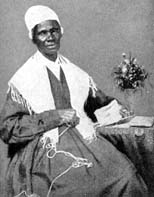
Ain’t I a Woman?
Sojourner Truth
(1797-1883)
That man over there says
That women need to be helped into carriages
And lifted over ditches,
And to have the best place everywhere
Nobody ever helps me into carriages
Or over mud-puddles,
Or gives me any best place!
And ain’t I a woman?
Look at me!
Look at my arm!
I have ploughed and planted,
And gathered into barns,
And no man could head me!
And ain’t I a woman?
I could work as much and eat as much as a man
When I could get it
And bear the lash as well
And ain’t I a woman?
I have borne thirteen children
And seen them most all sold off to slavery
And when I cried out with my mother’s grief
None but Jesus heard m1!
And ain’t I a woman?
That little man in black there,
He says women can’t have
As much rights as men
‘cause Christ wasn’t a woman!
Where did your Christ come from?
From God and a woman!
Man had nothing to do with Him!
If the first woman God ever made
Was strong enough to turn the world
Upside down all alone
These women together ought to be able to turn it back
And get it right side up again!
And now they is asking to do it
The men better let them.
Sojourner Truth, born as Isabella in Hurley, Ulster County, New York, was one early abolitionist and feminist in America. Before fleeing herself to freedom in 1827, she was a slave and had already witnessed the sale of two of her surviving children when she settled as a domestic servant with her youngest son and daughter in New York City around 1829.
In her most well-known speech above—Ain’t I a woman? we can see how she criticized the unfair treatment toward the Negro women confronted the appearance of the Cult of True Womanhood in the beginning of the nineteenth century.
One impact resulted in the Industrial Revolution in the beginning of the nineteenth America is the domesticity of women. Society considered women as the weaker sex so that women needed to be protected. While in the previous centuries women together with men could be the breadwinner for the family (such as doing agriculture, home industry), the industrial revolution with the establishing of factories spread all over America gave ideas to men to domesticate women at home and be the breeder, the cook, and the exclusive servant for the husband and the children they delivered. The reason—just like the reason mostly used by selfish men nowadays—was that men were already outside of home most of the time so that women had to stay home to take care of the children.
However, such principles were not applied to all women; they were only for white women coming from the middle and high social class. The “protection” was only given to them, but not to others, let’s say white women from low social class (e.g. the new immigrant who had to work hard to survive) and Negro women. This is exactly what Sojourner Truth criticized in her speech.
The impact of this application is:
For white women coming from middle and high social class, gradually working outside home was something coveted very much after they were bored to be domesticated and “protected”. Therefore they struggled to get their rights to be equal with men by pursuing career outside home. This could be seen as the one struggled by the second wave feminist movement in 1960s.
For Negro women—and also for women coming from low social class, working hard outside home bored them and they considered being a housewife—being idle, “only” doing household chores they believed not as hard as working outside to augment the income—as something luxurious. On the contrary of the white women coming from middle and high social class, they struggled something different.
Going back to Sojourner Truth’s speech, she also criticized the religious bodies that put women in the lower position than men with reason that Christ was a man. I am of opinion that Muslim women can also use the similar reason to respond Muslim men’s accusation that women are not as capable as men to be leaders or to have equal rights as men to pursue career outside home coz all prophets Muslim people know were men. Those selfish men use this “weapon” to eliminate any struggle for women to be leaders. As Amina Wadud illustrates in her book Quran and Woman: Rereading the Sacred Text from A Woman’s Perspective that men want to ignore the existence of women as the leaders in Alquran in order that men will always become the leaders in this world and women will only be the followers.
PT56 12.37 150706
Friday, July 14, 2006
The Housewife 1

THE HOUSEWIFE
Charlotte Perkins Gilman
(1860-1935)
Here is the House to hold me–cradle of all the race;
Here is my lord and my love, here are my children dear–
Here is the House enclosing, the dear-loved dwelling place;
Why should I ever weary for aught that I find not here?
Here for the hours of the day and the hours of the night;
Bound with the bands of Duty, rivetted tight;
Duty older than Adam–Duty that saw
Acceptance utter and hopeless in the eyes of the serving squaw.
Food and the serving of food–that is my daylong care;
What and when we shall eat, what and how we shall wear;
Soiling and cleaning of things–that is my task in the main–
Soil them and clean them and soil them–soil them and clean them again.
To work at my trade by the dozen and never a trade to know;
To plan like a Chinese puzzle–fitting and changing so;
To think of a thousand details, each in a thousand ways;
For my own immediate people and a possible love and praise.
My mind is trodden in circles, tiresome, narrow and hard,
Useful, commonplace, private–simply a small backyard;
And I the Mother of Nations!–Blind their struggle and vain!
I cover the earth with my children–each with a housewife's brain.
Charlotte Perkins Gilman is one favorite feminist writer of mine. Spending half of her time in the end of the nineteenth century America, Gilman of course still underwent the cult of True Womanhood in which one of the tenets is the cult of domesticity—being a housewife.
Appearing in the beginning of the eighteenth century, the cult of True Womanhood soon got a strong support from the religious bodies. The clergymen “trickily” and quickly were trying to find some verses in the Bible to strengthen the place for women—at home; forgetting that in the previous centuries women were also active in the public sphere. Not wanting to leave the puritan heritage of their ancestor as a pious nation, Americans put the burden to raise pious children to women’s shoulders. These pious children would be the future national leaders. The “interference” of the religious bodies successfully made most women coming from middle and high social class easily believed that they were born to stay home, to do household chores, to serve the husbands who worked in the industry outside home (after the Industrial Revolution was spread from England starting in the end of the seventeenth century and America in the beginning of the eighteenth century.
Gilman was one victim of the mother who strongly believed that she was born to stay home, no matter what happened. Her father left her mother and the two children in 1869. Her mother’s financial dependence forced them to move from one relative’s house to another, nineteen times in eighteen years. This also made the mother not able to show the care and love the children needed.
This bitter childhood made Gilman determined since a very young age to think that it was important for women to be financially independent. Being a full housewife would hamper a woman to be financially secure coz a woman wouldn’t have enough time to actualize her own skill, talent, and want. She wouldn’t have ample time to pursue her own career.
The poem I quoted above clearly shows Gilman’s criticism of the pride to be a housewife for women during her era.
In the first stanza, Gilman’s choice of word “lord” shows the unequal relationship between the husband and the wife. The word “lord” is used to show respect for someone who has a higher status. The husband—man—is the superior, while the wife—woman—is the inferior. A mother is even also less important than the children.
This condition is also criticized by Aquarini when her husband complained to her, “Why can’t you be an ordinary wife coz I am also only an ordinary husband?” After trying to find out what is the definition of “ordinary wife”, she came to a conclusion where one of them is when the family having meals, this housewife who has busily prepared the meals must let the husband eat first while she feeds the small children. After everybody is full, it is time for the “good” wife to have her own meal. After that, the husband will watch television or read newspapers, the wife continues working—doing the dishes. This illustration shows that the husband—the one who earns the money—is the “lord”, the respected one. The woman is the inferior.
The second stanza illustrates how doing the household chores has become the main duty for a housewife, all day long. It shows that the working hours for a housewife are almost for twenty-four hours. When can she have her own leisure time to do things she wants to enjoy for herself? However, a woman must accept it. Stanzas three and four explain more what a housewife must do—preparing the meals and clothes for the whole family members.
The last stanza is Gilman’s ultimate criticism of the existence of housewife as one “profession” for women in that era. When a woman is busy doing all those household chores and she doesn’t have time to improve knowledge, and do other intellectual things, how can society put the burden of raising the future national leaders on the shoulders of women whose mind is always occupied with doing household chores?
PT56 11.45 140706
Subscribe to:
Posts (Atom)